


When did modern MMA begin? A look at the UFC's development from 1993 to today.
The form of mixed martial arts we now know as MMA began in the early 1990s, when a number of innovators set out to answer a simple question: which fighting style is most effective? As a result, a one-night tournament was held in Denver, Colorado, an event that marked the start of modern MMA. From this bold experiment, the global Ultimate Fighting Championship (UFC) grew and transformed cage fighting from a rough show into a popular sport.
A Wild Beginning in 1993: UFC 1 and the Birth of Modern MMA
On November 12, 1993, the world of combat sports changed forever at a packed event in Denver. That night, Ultimate Fighting Championship 1 (UFC 1) took place as a no-holds-barred tournament in which experts in different martial arts fought one another. The contest had few rules, no weight classes, and no judges; the fight could end only by knockout, submission, or a trainer throwing in the towel. It was a true “anything goes” event (except biting and eye-gouging), since the objective was to find out which martial art was superior in a real fight.
The idea was originated by Rorion Gracie, a member of the well-known Gracie family who practiced Brazilian jiu-jitsu, and Art Davie, an American entrepreneur. The two set up the UFC under the WOW Promotions name to have several different fighting styles compete in the same event. The concept was sometimes called a “War of the Worlds” within the martial arts community, with karate, wrestling, boxing, and jiu-jitsu competing against each other.
The tournament results both surprised and delighted spectators. Although many expected a big, strong boxer or kickboxer to win, a relatively slim Brazilian fighter named Royce Gracie rose to the top. Donning a traditional gi, Royce (Rorion’s younger brother) fought three opponents in one night and defeated them all by submission. He used techniques specific to his family’s Brazilian jiu-jitsu grappling to tie up a boxer, a shoot-fighter, and a karate black belt, causing each to surrender. By the end of the event, Royce Gracie had been awarded the title of first UFC tournament champion and had clearly shown that technique and leverage could overcome raw size and strength. The tournament established Brazilian jiu-jitsu’s status and signalled the emergence of a new type of fighting in which fighters had to be well-rounded. Looking back, UFC 1 is generally regarded as the origin of modern MMA because it demonstrated the effectiveness of combining different martial arts traditions in real combat and laid the foundation for the sport’s future development.
Nobody at the time believed this single event would spark a global sports phenomenon. The early UFC was portrayed as the toughest possible test, consisting of a hard-fought one-night match in the cage with ‘no rules’ and being more like a pay-per-view novelty than a properly organised sport. However, this was about to change because of both the controversy and the innovation.
Backlash and Evolution: From “No Rules” to Regulated Sport

The pay-per-view viewers gave the early UFC tournaments, held between 1993 and 1995, a kind of cult status, but many people were also concerned. The extreme brutality and lack of rules led to heavy public criticism, with politicians and media figures attacking the organisation for its bloodsport nature. In 1996, U.S. Senator John McCain famously referred to the UFC as “human cockfighting” and asked the various states to ban it. This criticism marked a turning point: afterwards, pay-per-view companies stopped showing UFC events, and by the end of the 1990s, no-holds-barred fights had become illegal in 36 states. Legal and political pressure had nearly brought the previously unregulated event to a close.
With extinction a real threat, the UFC was forced to change. In the mid-1990s, the people in charge began introducing rules and broadcasting the events to make the sport safer and more acceptable to athletic commissions. Time limits were introduced so fights wouldn’t go on forever (early UFC fights had no clock to track rounds). In 1997, weight classes were introduced to stop smaller fighters from having to face much larger opponents. Techniques such as fish-hooking (that is, gouging the cheek), strikes to the groin, and headbutts were gradually banned. By 1999, referees were allowed to get fighters to their feet when the fight stalled, and a judging system was put in place to decide the outcome of a match. Starting with UFC 14 in 1997, fighters began wearing padded gloves to protect their hands and reduce facial cuts. This series of changes reached its peak in 2000 when the California State Athletic Commission (and later New Jersey) helped to establish the Unified Rules of Mixed Martial Arts, a complete set of rules defining the length of the rounds (five minutes each), the criteria for judging, and the fouls in the sport. What had originally been known as “No Holds Barred” fighting was now being called “Mixed Martial Arts”, having acquired a rulebook and a structured framework that gave it legitimacy.
The reforms were successful. Although the UFC in the late 1990s had a smaller audience, it was no longer seen as a lawless fight taking place in a warehouse. Gradually, the sport was gaining acceptance. The new rules made the matches safer and more professional, allowing the UFC to return to cable pay-per-view and even obtain sanctioning in some states. Most importantly, the changes kept the UFC alive during its worst years, just barely. By the end of the 1990s, the organization faced financial difficulties and was still banned in most areas, but it had survived long enough to get a second chance.
The Zuffa Takeover and a New Era (2001)

In January 2001, the UFC turned a corner when two ambitious casino owners from Las Vegas bought the struggling organisation. Frank Fertitta III and Lorenzo Fertitta, together with their high school friend Dana White, bought the UFC for just $2 million, which was a good price to pay for a business that was almost bankrupt but still enjoyed a cult following. The Fertittas set up a new parent company, Zuffa LLC, and appointed Dana White as president of the UFC. This new management team aimed to take the UFC into the mainstream.
When Zuffa took control, the UFC adopted the Unified Rules to gain recognition through official regulation. White and the Fertittas worked closely with the state athletic commissions to get MMA acknowledged as a sport, not a street-fighting show. In practice, this meant removing any remaining rough elements, ensuring doctors and EMTs were present, enforcing weight classes and rules consistently, and presenting MMA as ‘ultimate fighting’ in a controlled, sportsmanlike way. Although the eight-sided cage (the ‘Octagon’) remained, the sport’s image had changed.
Despite improved organisation, the UFC still lost money from 2001 to 2004. The new owners put a great deal of energy into marketing, video production, and recruiting skilled fighters, but by 2004 they were said to have lost tens of millions of dollars just to keep the UFC going. The audience remained relatively small, and a great many mainstream sponsors and TV networks continued to be wary of the violent image connected with cage fighting. Dana White and the Fertittas were so disheartened that they had almost decided to sell the business around 2004, believing that the UFC would never succeed. They had no idea that the breakthrough was just about to happen.
“The Ultimate Fighter” and the Mainstream Breakthrough (2005)
In a final attempt to promote MMA, the UFC owners opted for a radical idea: reality television. They financed a television programme named ‘The Ultimate Fighter’ (TUF), which first aired on Spike TV in early 2005. The programme portrayed sixteen fighters who lived and trained together, competing for a contract with the UFC. Throughout most of its first season, The Ultimate Fighter had a fairly small audience, until the live finale on April 9, 2005, which included a light-heavyweight match between Forrest Griffin and Stephan Bonnar. What happened that night has since become legendary.
The fight between Griffin and Bonnar became a grand melee, a back-and-forth battle that lasted three rounds, with both fighters giving it their all and constantly trading punches. The contest was raw, dramatic, and extremely exciting. While it was being broadcast live, viewers at home began phoning their friends so they could watch, and the television ratings rose round by round. Millions of people watched these two fairly unknown fighters put on one of the most exciting fights in MMA history. Although Forrest Griffin won by decision, UFC management made a rare move and gave contracts to both fighters, acknowledging that their performance had won over a nation of fans.
Dana White later said that fight saved the UFC, and that is no overstatement. The spectacular Griffin-Bonnar match showed that mainstream American audiences would become enthusiastic about MMA if given the opportunity. Almost immediately, the UFC’s image changed: people no longer viewed it as a brutal bloodsport but as an exciting form of legitimate competition involving skilled athletes and great determination. Because of the finale’s success, interest in MMA surged, prompting Spike TV to air more UFC content. Sponsorship deals came in, ticket sales rose, and new television agreements were reached. The UFC, which was on the verge of going bankrupt, saw its popularity rise dramatically.
The Ultimate Fighter programme went on for several seasons (and, as a result, produced future stars including Michael Bisping, Rashad Evans, and Nate Diaz). Still, its most significant achievement was the first finale. This event marked the start of a period of growth for the UFC, when MMA finally came to the notice of the general public. As the UFC commentator Joe Rogan stated, the fight between Forrest Griffin and Stephan Bonnar was the UFC’s ‘lightning in a bottle’ moment, the point at which a large audience exclamation was ‘Wow, this is something special’.
Expansion, Superstars, and Worldwide Reach (2006-2010s)
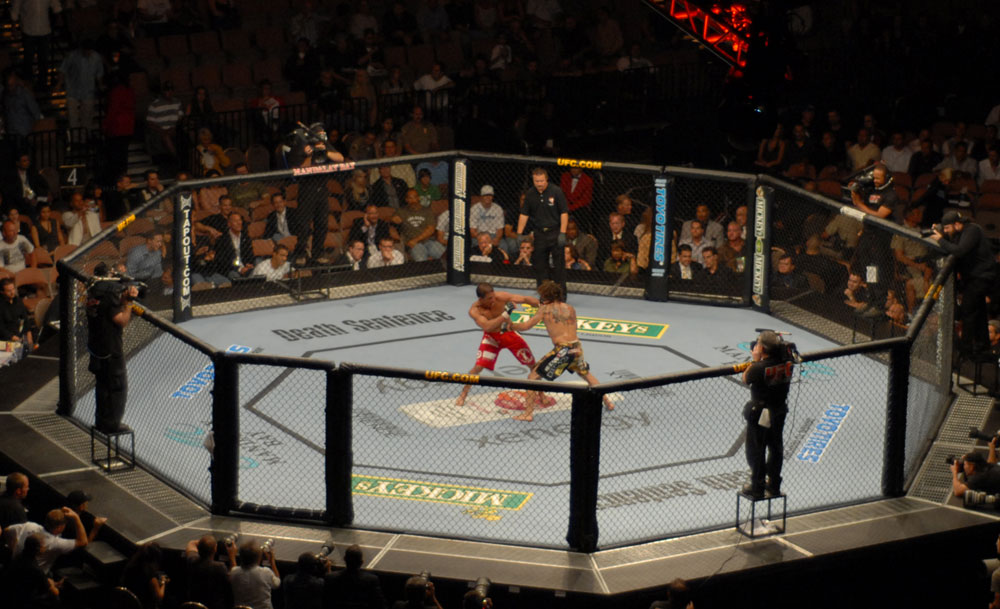
The UFC carried that momentum and expanded quickly in the late 2000s. It started by taking over competing MMA organisations and bringing in the best fighting talent from around the world. In 2006, Zuffa (the group that owned the UFC) bought two smaller promotions, the World Fighting Alliance (WFA) and World Extreme Cagefighting (WEC), and took many of their fighters into the UFC. Even more importantly, in March 2007 the UFC purchased Pride Fighting Championships, the leading Japanese MMA organization with a large number of international stars. This move was a breakthrough because it brought together the best fighters from the East and the West under one umbrella, enabling the kind of matchups fans had long imagined. Fighters such as Mirko “Cro Cop” Filipović, Antônio Rodrigo Nogueira, Maurício “Shogun” Rua, Dan Henderson, and Wanderlei Silva eventually joined the UFC after Pride folded, establishing the UFC as the dominant MMA league worldwide.
During this period of growth, the UFC also created new weight classes and divisions to include more athletes. The lightweight division (155 lbs) returned, and lighter classes, such as the featherweight (145 lbs) and the bantamweight (135 lbs), were introduced from the WEC. This meant fans now had a complete range of weight classes, from the flyweights at 125 pounds to the heavyweights at 265 pounds. The sport had stopped being about matching sumo wrestlers against karatekas; it had become a competition among well-rounded mixed martial artists across multiple weight categories, each aiming for a championship belt.
A breakthrough was the inclusion of women’s MMA in the UFC. For the first twenty years, the UFC had been a competition open only to men. Dana White had indeed famously stated in 2011 that women would “never” take part in the UFC, but he was quickly shown to be wrong. The talent and popularity of female fighters had been increasing in other promotions (such as Strikeforce), and by the end of 2012 the UFC management changed their position. They signed Ronda Rousey, a former Olympic judo medalist, and made her the first women’s bantamweight champion. At UFC 157 in Anaheim in February 2013, Rousey headlined the event against Liz Carmouche, marking the first women’s fight in UFC history. The match was a great success; Rousey won with her signature armbar submission, and the audience was delighted. It showed that women’s fights could generate as much excitement as men’s. This achievement paved the way for women’s athletes in the UFC, leading to the creation of several female divisions and the rise of new stars such as Holm, Tate, Nunes, and Shevchenko in the years that followed. What had once seemed impossible, women headlining UFC events, soon became the norm, widening MMA’s appeal.

By the mid-2010s, the UFC had developed into a global sports powerhouse. The organisation put on events not only in Las Vegas but also in Europe, Brazil, Canada, Australia, and Asia. Major television networks began covering MMA alongside other sports. The clearest sign of the UFC’s acceptance into mainstream culture was the rise of crossover superstars. Fighters such as Georges St-Pierre and Anderson Silva became heroes in their home countries; Ronda Rousey appeared on magazine covers and on TV talk shows; and the Irish talent Conor McGregor made a huge entrance as a must-see figure worldwide. McGregor, who first fought in the UFC in 2013, had a swaggering style of trash-talking and delivered knockout blows perfect for highlight reels, attracting millions of new fans. McGregor and Rousey, in particular, became well-known figures, appearing in films, advertisements, and at night-time interviews, unlike in earlier days when UFC fighters were unknown. In 2016, McGregor’s championship fight against Khabib Nurmagomedov set the UFC pay-per-view sales record (with over 2 million buys), showing how large the sport’s fanbase had grown.
The UFC’s economic growth went hand in hand with its cultural rise. In July 2016, the Fertitta brothers chose to exit the business, selling the UFC to a group led by the entertainment company WME-IMG (now Endeavour) at a remarkable valuation of $4 billion. At that time, this was the highest amount ever paid for a sports franchise, beating the values of well-known teams such as the Los Angeles Dodgers or Manchester United. This astonishing transaction proved that MMA, once regarded as a marginal form of entertainment, had become a major business on par with other major sports. The new owners then extended its television agreements (eventually working with ESPN) and continued its global expansion by holding events in new countries and signing fighters from around the world.
Timeline

-
November 12, 1993
UFC 1: The Beginning
The inaugural UFC show takes place in Denver, Colorado, and features a no-holds-barred tournament aimed at identifying the most effective martial art; Royce Gracie, a practitioner of Brazilian jiu-jitsu, wins by submitting three opponents in that single event, demonstrating that technique can overcome raw strength.
-
1996
Public Protest and Rule Changes
Senator John McCain described the UFC as “human cockfighting” and as a result many bans were enacted. In response, the UFC introduced weight classes, time limits, and other rules to improve safety and acceptability.
-
January 2001
Zuffa Era Begins
Frank and Lorenzo Fertitta bought the UFC and appointed Dana White as president; the new owners then worked with the athletic commissions to sanction MMA under the Unified Rules, turning it into a regulated sport.
-
April 9, 2005
The Ultimate Fighter Finale
Forrest Griffin and Stephan Bonnar fight in a televised finale that captivates millions, and their dramatic match is said to have saved the UFC and brought MMA into the mainstream, as fan interest and television contracts increased afterwards.
-
March 2007
Pride FC Acquisition
The UFC takes over the Japanese Pride Fighting Championships, bringing together the world’s best MMA fighters under a single promotion. As a result, the UFC’s roster grows and its international popularity increases, creating exciting matchups for fans.
-
February 2013
Women Debut in the UFC
At UFC 157, the first event to feature a women’s match, Ronda Rousey and Liz Carmouche fought in the main event, and the bout’s success shows that female fighters can attract substantial interest and further legitimise MMA.
-
July 2016
UFC Sold for $4 Billion
WME-IMG (Endeavour) purchases the UFC for $4 billion, the largest transaction in the sports world at the time. This deal shows the UFC’s remarkable journey from a marginal spectacle to a major sports force.
-
June 14, 2026
UFC Freedom 250 at the White House
The UFC holds a fight card on the South Lawn of the White House as part of the celebrations for America’s 250th anniversary. Justin Gaethje upsets Ilia Topuria to win the undisputed lightweight title, and all seven bouts end by knockout or TKO. Thirty years after being called “human cockfighting,” the sport is featured at the White House.
Conclusion: From Fringe to Phenomenon
.jpg)
Then, when did MMA begin in its present form? The foundations were laid with UFC 1 in 1993, a single-night trial which sparked interest. Nevertheless, modern MMA really took shape in the years that followed, as the UFC established a set of rules and appointed new leadership to survive the 1990s, then burst onto the mainstream scene in the mid-2000s with the growth of reality television and some truly memorable fights. What started as an underground event has, over decades, developed into a well-regulated sport and a global entertainment giant.
The UFC is now viewed in more than 165 countries and has events held in arenas in Las Vegas, London, and Tokyo. The fighters it features are top-class athletes with expertise in multiple disciplines, unlike the one-dimensional brawlers of 1993. Fighters such as Ronda Rousey and Conor McGregor have become pop-culture celebrities, and in the public’s mind MMA has established itself as a mainstream sport on a par with boxing and professional wrestling.
The history of the UFC shows how modern MMA didn’t begin on a single night but rather through a series of important milestones: the Gracie family demonstrating the value of grappling in 1993, the difficult reforms and near-collapse of the late ’90s, the bold move into reality television in 2005, which proved to be a huge success, and the decade characterised by top stars and large sums of money that came afterwards. Each stage added a further element to what MMA is today. From its chaotic origins to its current refined state, the UFC’s history clearly shows innovation, resilience, and the lasting appeal of pushing oneself to the limit in combat.
Modern MMA may have begun in 1993, but it truly developed in the years that followed, eventually becoming the multi-billion-dollar sport we know today. And since the UFC has kept on expanding (as shown by its recent decision to merge with corporate counterparts such as WWE), the influence of those early days is evident: the very question which launched it all, ‘Which martial art is best?’, has led to a sport in which the answer is all of them, combined and now being showcased under a bright spotlight for the world to enjoy.


Leave a comment